Review: Trio Seoul Wows the Audience at the Northwestern Winter Chamber Music Festival
JANUARY 20, 2026 by LOUIS HARRIS
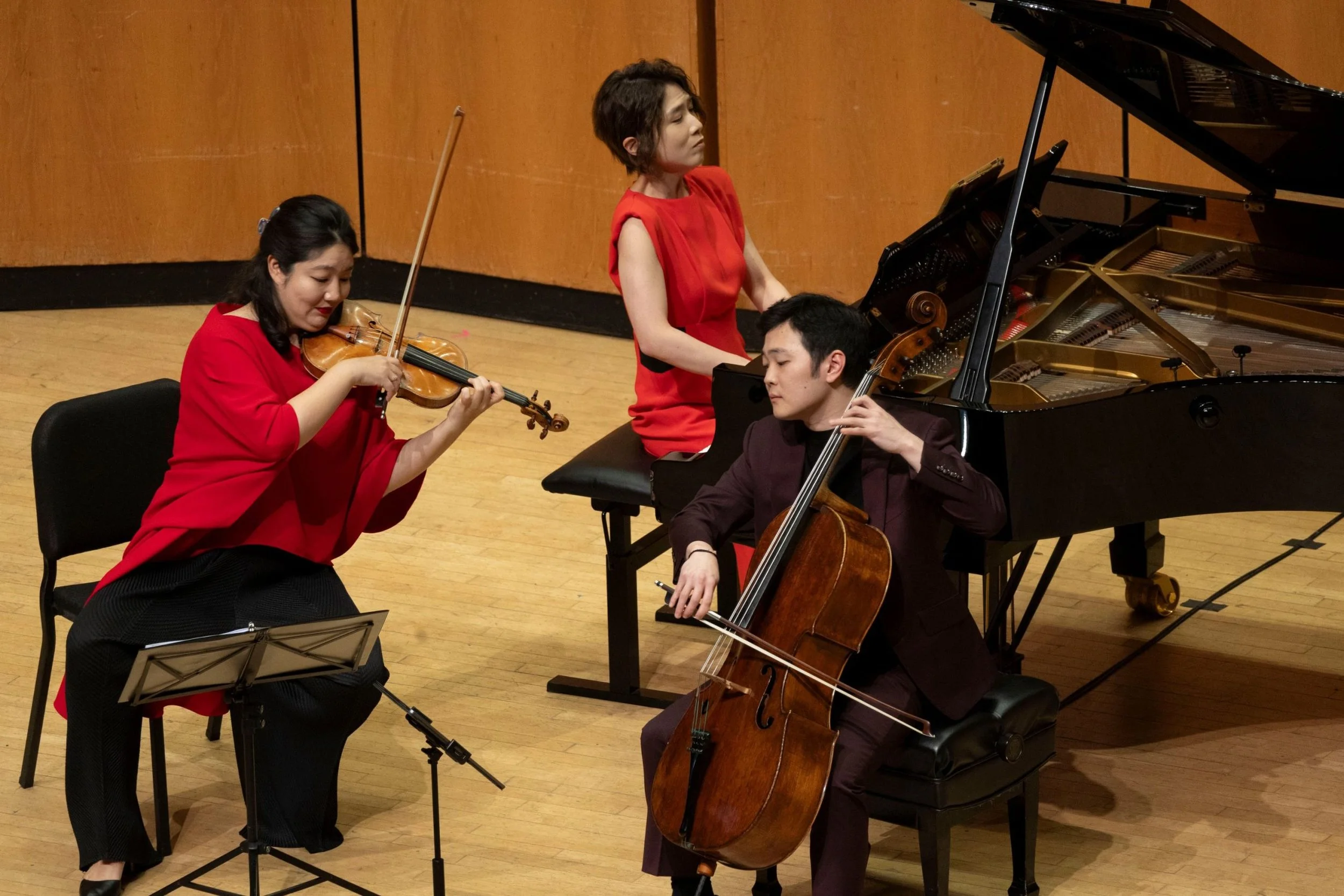
Trio Seoul. Photo by Andi Griñé.
With an unbelievable combination of youthful exuberance and mature technique, Trio Seoul wowed a large audience at Pick-Staiger Concert Hall in Evanston on Sunday. They did it with a program of four infrequently performed works from the current century and each of the previous three. Sunday’s performance, their first appearance at the Northwestern Winter Chamber Music Festival, showed that, from whatever age they draw their material, they play it with aplomb.
With an unbelievable combination of youthful exuberance and mature technique, Trio Seoul wowed a large audience at Pick-Staiger Concert Hall in Evanston on Sunday. They did it with a program of four infrequently performed works from the current century and each of the previous three. Sunday’s performance, their first appearance at the Northwestern Winter Chamber Music Festival, showed that, from whatever age they draw their material, they play it with aplomb.
All three players had many opportunities to display amazing talent as soloists and in ensemble arrangements. There was an occasion when cellist Brannon Cho played pizzicato and pianist Kyu Yeon Kim played six staccato notes, all but one of them were perfectly simultaneous. Their intonation was great, helped by frequent pauses to tune between movements, which did not always seem necessary.
Jinjoo Cho’s precise playing fit in very well. She wore a bright red, loose-fitting, smock-like gown that flowed down her arms. She was very animated. Whenever she moved, her gown moved with her and it created an unusually compelling visual.
The program opened with Franz Joseph Haydn’s most famous piano trio, labeled in the program as No. 39 in G-Major. Haydn wrote 43 piano trios. In the Hoboken catalogue, this late work bears the number 25, with several trios written earlier given higher numbers. It also has been given the sobriquet “Gypsy” for the Hungarian rondo in the finale.
One of the unfortunate realities is that Haydn’s amazing piano works are overlooked. The piano trios are especially ignored because most of them are really piano sonatas with string accompaniment, where the violin and cello simply follow the piano. Although they are great musically, they are not all that interesting for string players, so why play them?
Toward the end of his career in the 1790s, Haydn liberated the violin, and this trio allowed Jinjoo Cho and Kyu Yeon Kim to demonstrate terrific technique, while Brannon Cho followed along admirably. As an ensemble, it was magical. I don’t recall ever hearing a more rambunctious rendition of this great work.
Fast forward 230 years to 2024, when Korean-born, American composer Juri Seo composed the stunning July Mountain. Jinjoo Cho talked about it at length, echoing the description in the notes how it was work for the summer, written in the winter. She describing its three sections, “Matasequoia” (Dawn Red Pine), “Golden Bells,” and “Sonamu” (Korean Red Pine).
It opens with deep chords on the piano, with the violin and cello playing long notes double stopped. It eventually morphs into stormy terrain. “Golden Bells” is short, with both of the Chos playing harmonics up and down the fingerboard.
The most intense part is “Sonamu.” Seo which was inspired by the grief she felt after the Jeju Air flight accident in Seoul on December 29, 2024, where 179 people were killed. Sadder music is hard to find, and Trio Seoul clearly owned it.
The sadness continued with Tristia an interesting transcription for piano trio that Franz Liszt made of his own piece for piano solo, Vallée d'Obermann, originally from the 1830s. The notes explained how Lizst based the work on a story of the same name about a hero dealing with sadness and existential personal doubts. The trio, transcribed in the 1880s, was given a new name, Tristia, “Sorrow.”
Following the finale of July Mountain, Tristia fit right into the program, and Trio Seoul gave it typical passion. I was curious to see how Kyu Yeon Kim handled this weepy but flashy piano part. She played it very cleanly. It was really nice to hear chamber music with strings by Liszt.
Following intermission, Trio Seoul gave a spirited performance of Maurice Ravel’s Piano Trio in a-minor. Written just as World War I was starting, Ravel poured lots of passion and emotion into this piece, which the performers reproduced splendidly. The opening movement is in sonata form, with a French tempo label of Modéré. Trio Seoul showed excellent contrasts between main and secondary themes. The opening movement ends quietly, and, after a quick tune-up, they frolicked in the Scherzo, labeled Pantoum: Assez vif.
The Northwestern Winter Chamber Music Festival continues this Friday with the Isidore String Quartet playing Haydn, Ligeti, and Brahms. Pick-Staiger Concert Hall, Evanston, Friday, January 23, 7:30 pm.
After a rather lengthy pause, the festival concludes with the Dover Quartet on Valentine’s Day. The program includes Schubert, Bacewicz, and Felix Mendelssohn. Pick-Staiger Concert Hall, Evanston, Saturday, February 14, 7:30 pm. For more information about these concerts, click here.
